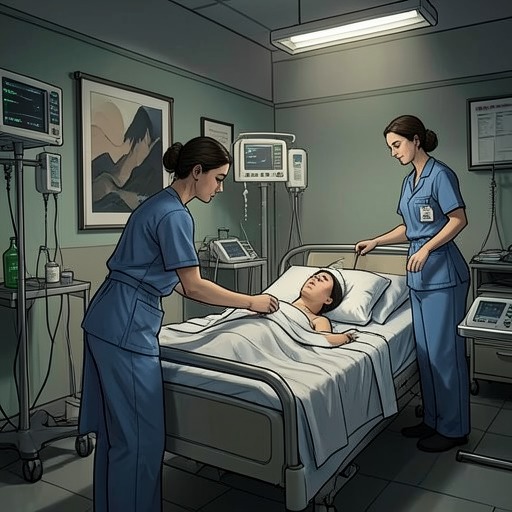
Ebola virus disease
The Hot ZoneEbola virus disease is the book’s central example of a lethal infection whose danger lies not only in its effects on individuals but in the way it can move through families, hospitals, and animal populations before its origins are understood. Its history is presented as a sequence of outbreaks and investigations: human transmission was most clearly associated with blood and bodily fluids, while experiments with monkeys showed that infection could also occur across a room by an uncertain airborne route. The virus’s natural reservoir, and the precise circumstances of its emergence, remain unresolved.
Disease and Clinical Course
The book describes Ebola as an exceptionally fast-acting virus that attacks the immune system and affects many tissues. Its account attributes this activity to a virus particle made up of seven proteins, four of whose structure and function were still unknown to researchers at the time. Rather than developing over years, as the account contrasts it with AIDS, Ebola can overwhelm a person in a matter of days. The illness is associated with fever, weakness, bleeding, and damage to internal organs; its severe course can include neurological effects. These features help explain why care for the sick and handling of bodies became consequential points of possible exposure.
The virus’s effects also shape the account’s language. It repeatedly describes infection through metaphors of amplification, catastrophe, and predation, presenting the virus as an agent that multiplies rapidly inside a host and can pass onward before the host dies. Such imagery conveys the scale and speed of the threat, but it does not establish that the virus acts with intention. The underlying practical concern is more specific: when a highly infectious agent enters a setting with repeated close contact, contaminated equipment, or inadequate protective measures, each new infection can extend the chain.
Outbreaks and Human Transmission
The first identified case in the 1976 Sudan outbreak was a cotton-factory storekeeper known as Yu. G., who became ill in Nzara and died at home. Bats roosted near his workplace, but the book stresses that their role was never proved; the route by which he acquired the infection remained unknown. After his death, two men who worked near him in the same room also became ill. One, P. G., had a wide social circle, and the narrative traces subsequent spread through personal contact, including sexual contact. The outbreak reached Maridi, where transmission in the hospital was associated with injections given using inadequately cleaned needles. As patients and medical workers became ill, the hospital itself became a focus of infection. The outbreak eventually subsided, but the exact reason is left uncertain; the flight of medical staff and the interruption of unsafe injections may have helped break chains of transmission.
A second emergence followed in 1976 in Bumba Zone, in northern Zaire. The first human case was never identified. The book offers several possible points of contact with an animal source, but none is established. At Yambuku Mission Hospital, five syringes were used to give injections to hundreds of patients, and staff did not consistently rinse the needles between injections. A schoolteacher who later became the first known case may have contracted the virus through one of these injections, possibly after an earlier patient had used the same needle. From the hospital, infection spread into surrounding villages and families, including through the care and preparation of the dead.
The journey of Sister M.E. from Yambuku to Ngaliema Hospital in Kinshasa became another important part of the outbreak’s history. After her death, the room where she had been treated remained closed for days because hospital staff feared entering to clean it. Sister E.R., who had traveled with her, also became ill. Nurse Mayinga N., who had cared for Sister M.E., later developed symptoms and moved around Kinshasa while ill. Medical teams identified thirty-seven people who had been in face-to-face contact with her and placed them in containment pavilions for observation. None of those contacts became ill, even though one had shared a bottle of soda with her. The outbreak did not spread through the city as officials feared, and the book presents this absence of transmission as evidence against easy spread through ordinary face-to-face contact in that episode.
Laboratory Findings and Containment
At the United States Army Medical Research Institute of Infectious Diseases, Eugene Johnson’s Ebola experiments were designed to test drugs in infected monkeys. Nancy Jaax, serving as the project pathologist, entered the negative-pressure Level 4 suite to examine the animals and determine their cause of death. The infected monkeys died despite treatment. The two uninfected control monkeys, housed across the room, initially remained healthy. Two weeks after an incident in which Jaax’s protective suit was breached but her final glove remained intact, however, the control animals developed signs of illness and died. They had not been deliberately inoculated and had not been housed with the infected animals.
The infection of the controls changed how researchers understood the possible routes of transmission. The book reports that the most likely explanation was inhalation of virus-containing droplets, perhaps produced when monkeys spat or when caretakers washed cages with hoses. Jaax later described this as the point at which she knew Ebola could travel through the air. The evidence concerned transmission among monkeys in a laboratory; it did not demonstrate that Ebola was readily airborne between people. In a separate 1986 experiment, Gene Johnson infected monkeys by having them breathe small amounts of Ebola or Marburg virus, showing that inhaled exposure could initiate infection in animals.
Jaax’s work also brought the competing obligations of veterinary care and medical research into view. She found the sick and dead monkeys distressing, having understood her veterinary role as a commitment to animal care, while also regarding research as a way to help prevent human suffering. Her decision to continue the work was framed by that conflict rather than by indifference to the animals. In the laboratory, containment depended on both procedure and equipment: negative air pressure was intended to draw air inward if a leak occurred, while protective suits and sealed rooms limited exposure. The accidental suit breach showed that such systems reduced risk without making it disappear.
Ecology, Uncertainty, and the Meaning of Emergence
The account does not identify Ebola’s natural reservoir. Gene Johnson had searched across central Africa without finding where Ebola or Marburg lived in nature. The 1976 cases leave several possible animal sources open, but the book does not treat any of them as confirmed. That uncertainty matters: identifying a place where people became ill is not the same as identifying the reservoir or proving the route by which the virus entered the human population.
The book sets this uncertainty against changing landscapes and patterns of animal contact. Around Mount Elgon, farms and settlements were encroaching on forest habitat as trees were cut for firewood and land was cleared for grazing; elephants were disappearing. Elsewhere, the account describes the trade and transport of wild monkeys around Lake Victoria, including the possibility that animals were crowded together and exposed to viruses from other species. It also discusses the broader hypothesis that emerging infections can accompany disturbance of tropical ecosystems and increased contact between people and wildlife. These are presented as ecological contexts and possible routes of risk, not as proof that a particular act of deforestation or animal trade caused a named Ebola outbreak.
The distinction between evidence and hypothesis is essential to the book’s treatment of disease. It links habitat change, wildlife handling, laboratory practice, and human settlement as circumstances that can create opportunities for viruses to cross boundaries, while repeatedly acknowledging that the specific host and route may remain unknown. Ebola virus disease therefore functions both as a medical emergency and as a test of what investigators can responsibly claim: an outbreak can be traced through patients and institutions even when the virus’s deeper ecological history remains hidden.